Leak Detection
Finding a hidden leak by locating it, not by opening walls to look for it.
San Diego water, leak, drain and sewer diagnostics — find the source before anyone opens a wall.
WaterLine ExpertsA wet patch with no obvious source. A drain that was cleared last year and is slow again. A bill that doubled while nothing about the house changed. Tell us what yours is doing and we will work out why before anything gets cut, dug or jackhammered.
Describe what is happening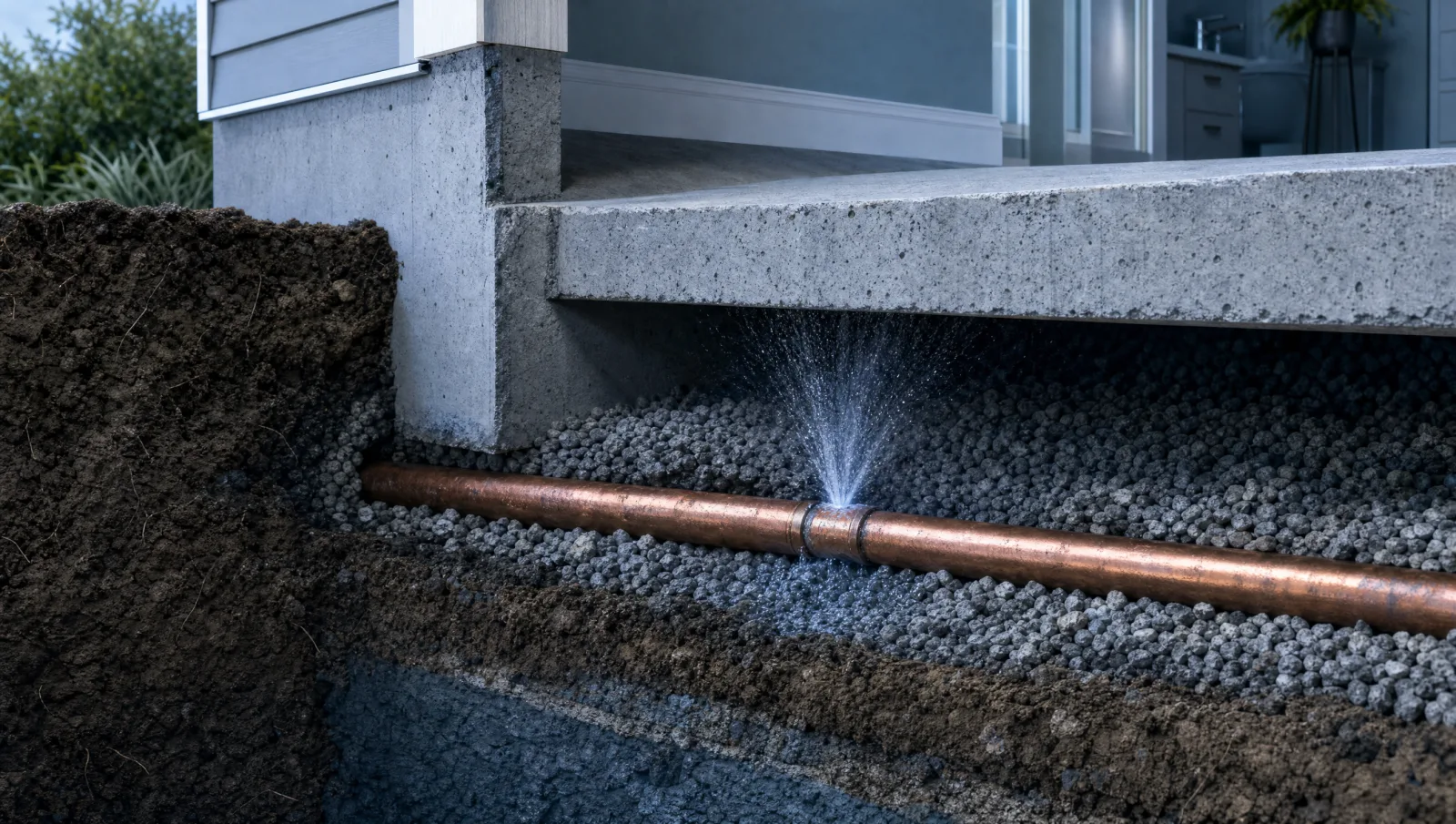
Finding a hidden leak by locating it, not by opening walls to look for it.
Pinpointing a leak inside the foundation before any concrete is opened.
Clearing the drain, and establishing why it filled up in the first place.
High-pressure pipe cleaning, and an honest account of the pipes it is wrong for.
Establishing what is actually wrong with the lateral before choosing how to fix it.
Which heater failures are repairable, which are not, and what the choice costs you later.
Fixing a located failure on the service line, without assuming the whole line has to go.
When the service line itself, not one spot on it, is the actual problem.
Replacing the interior supply system itself, when the pattern is the whole house, not one line.
Water actively escaping, right now — what to do first, and what the repair involves after that.
What actually counts as an emergency, immediate safety steps, and how form-based intake handles urgency.
Almost every expensive mistake in this trade is the same mistake: opening the wrong thing. A leak, drain and sewer problem announces itself somewhere convenient — a damp baseboard, a slow shower, a smell in one room — and that location is evidence, not an address. Water runs downhill inside a wall cavity before it appears. A blockage forms where the pipe is already deformed, not where the fixture is. A sewer smell travels along the path of least resistance from wherever the seal actually failed. Cut into the visible symptom and you get a repaired section of sound pipe, a patched wall, and the same problem again in a season. So the order is fixed here. Establish what the system is doing under pressure, narrow it to a spot with instruments rather than inference, confirm it, and only then talk about what opening it up involves. That order costs a little more time at the front and saves the part of the job that is genuinely expensive.
A great deal of San Diego housing sits on slab-on-grade foundations — the standard here since the tract building of the 1950s — which is why slab leaks come up far more often than in regions that build over crawlspaces. A supply line under a slab has no service access by design, so the diagnosis has to happen through the concrete rather than by lifting a hatch and looking. The water itself matters too. San Diego’s supply is hard: the city’s own reporting puts total hardness in the region of 216 to 284 parts per million depending on the treatment plant and the seasonal blend of Colorado River and State Water Project water. Sustained mineral content works on copper from the inside, which is the mechanism behind pinhole leaks in supply lines that were sound for decades, and behind the sediment that collects in the base of a water heater. The county also holds a wide spread of housing ages within a short distance. Homes from the postwar decades can still be on their original supply lines and, where the sewer lateral is clay, on joints that roots eventually find. Newer stock fails differently. Two houses a few streets apart can need entirely different questions asked of them, which is the argument against diagnosing anything from a description alone.
How to tell a hidden leak from a usage change, using the meter you already have.
The signs that point under the concrete, and the ones that only look like they do.
Why a cleared drain blocks again, and what would actually stop it coming back.
Where the smell is getting in, when it is harmless, and when to stop and ventilate.
A step-by-step, no-tools-needed sequence for narrowing down a suspected leak before anyone visits.
Nothing gets cut, dug or jackhammered until we can point at the spot and say why. If we cannot narrow it, we say that rather than opening something speculative.
Camera passes and findings are yours. Take them for a second opinion if that is what makes the decision feel solid — a diagnosis that only holds up when nobody else looks at it is not a diagnosis.
If the smaller fix will hold, we will say so. Quoting a whole line because it is simpler arithmetic is how this trade earned its reputation.
If your drain has already been cleared twice, the useful work is finding the reason, not selling a third clearing.
It usually means water is leaving the system somewhere it is not being used, and the places that hide a leak best are the ones with no visible surface — supply lines under a slab, under a driveway, or out in the yard between the meter and the house. A quick self-check: turn off every fixture and watch the meter. If it is still moving, something downstream of it is passing water.
Not to find it. Locating is done through the slab, using acoustic equipment to hear pressurised water escaping and thermal imaging to trace the warm track a hot-side leak leaves across the floor. Opening concrete is a repair decision that comes after the location is confirmed, and it should never be the way the location gets established.
Because clearing a blockage does not change the condition that produced it. A cable punches an opening through the obstruction and flow returns, but whatever the material was catching on — a buildup layer on the pipe wall, a section that has sagged and holds water, a joint that has shifted, roots coming through a crack — is all still there. A camera pass answers why; a third clearing does not.
The condition of the pipe from the inside: where it runs, what it is made of, whether it holds standing water, whether joints have separated, whether roots have come through, and whether there is a crack or a collapse. It is the difference between knowing a line is blocked and knowing whether cleaning it will hold.
Sewer gas is getting past something that should be sealing it off. The common causes are a trap that has dried out in a fixture nobody uses, a failed wax seal under a toilet, or a break in a vent or drain line inside a wall. Nothing backing up is normal for all three — the smell is a sealing problem, not a flow problem.
No, and most people do not. Describing what you have noticed and when it started is more useful than a guess at the cause. Working out the cause is the job.
A sentence or two about what you noticed, where, and roughly when it started is enough to start with. We will come back by email.
Request ServicePrefer to call? (619) 391-3249